
A good About us page tells visitors who is behind the business, why it exists, and why they can trust it, in a way that sounds like the people who run it. Most include a short story, the faces of the people a customer will deal with, a few proofs such as clients, credentials or numbers, and a clear next step. The best ones choose one of those to lead with and keep the rest short.
Below are ten About page examples, each built around a different idea, followed by what to put on yours and how to write it. Every example is a template on Siter.io, so the businesses and people are invented, but each one solves a real problem you will face on your own page.
1 Lead with your history: Vinha Alta
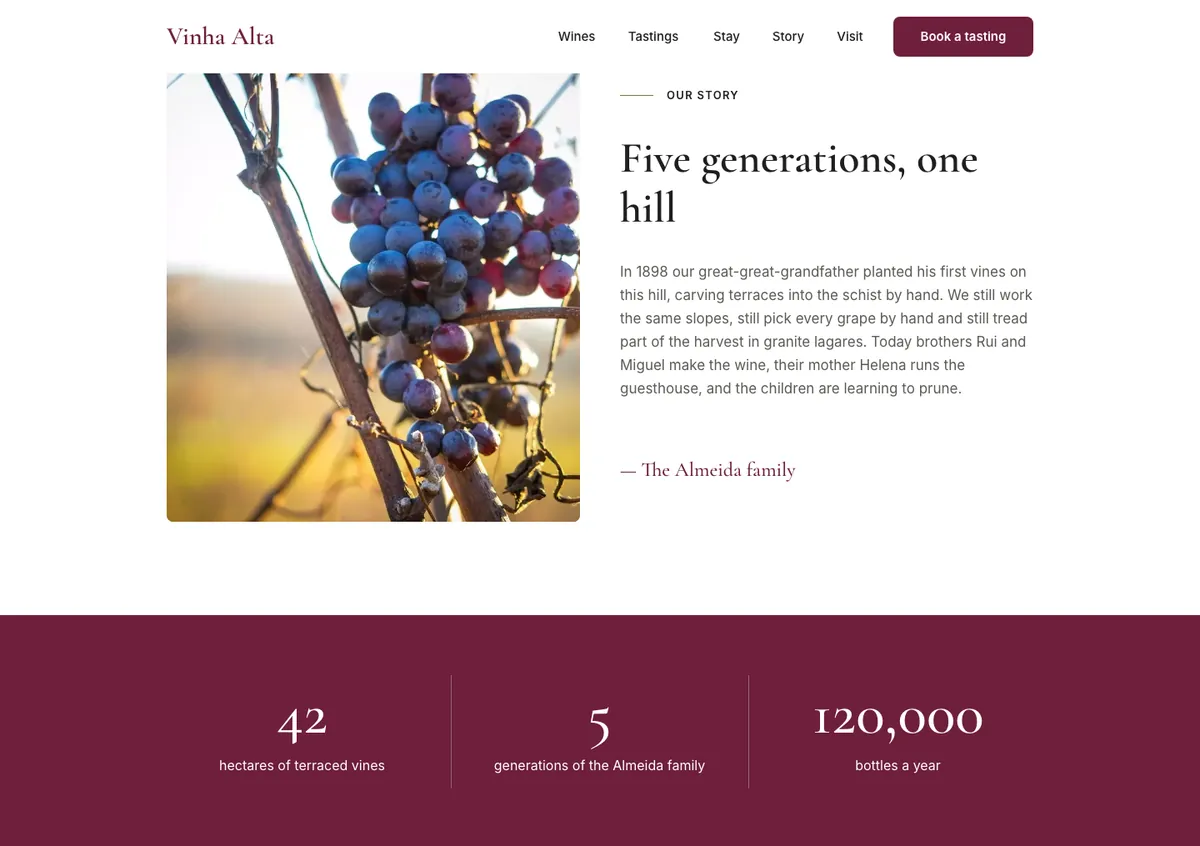
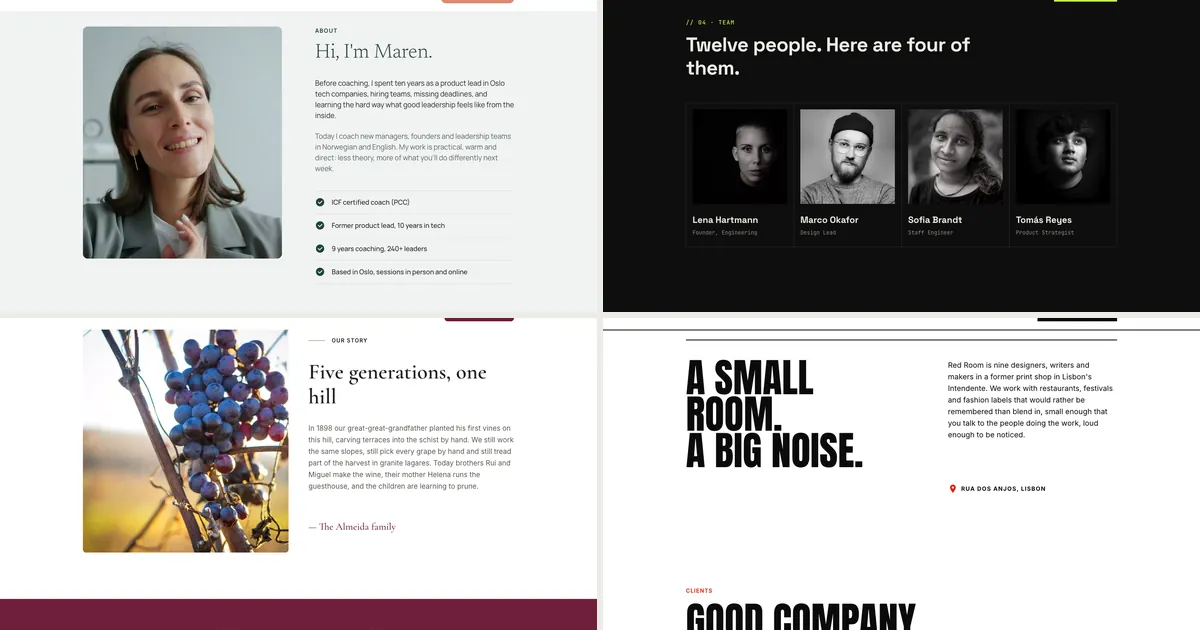
If your business has a long history, it is your strongest argument, so open with it. This winery gives one paragraph: who planted the first vines and when, what is still done by hand, and who runs it today, down to the children learning to prune. It is signed by the family rather than “the team”, and a band of three numbers turns the story into facts a visitor can remember.
Take from it: name real people and real years. “Since 1898” means more than “a long tradition”.
2 Introduce yourself in the first person: Maren Holt
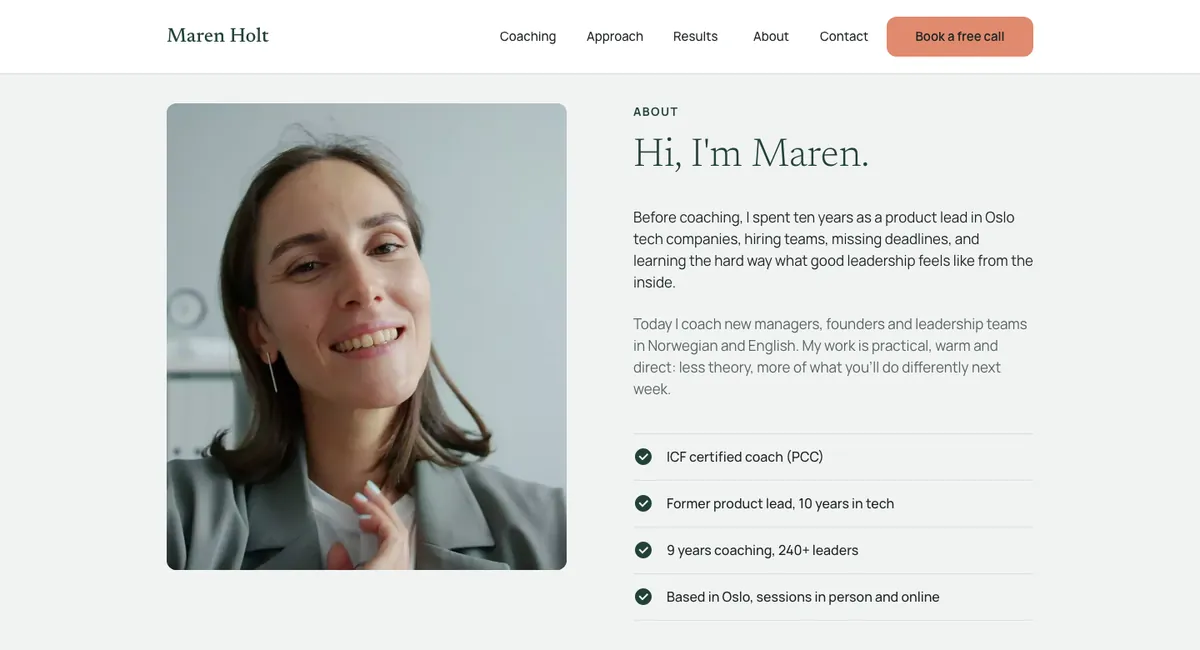
When the business is one person, the About page is a first meeting. Write it in the first person, start with a greeting, and show your face. Maren’s first paragraph is how she got here; the second is who she works with and how. Then four short facts answer the questions a cautious client asks before booking: her certification, her background, how long she has coached and where she works.
Take from it: turn your credentials into a short list under the story, not a paragraph inside it. Freelancers can use the same shape; see websites for freelancers.
3 Show the people a customer will work with: Hart & Vale
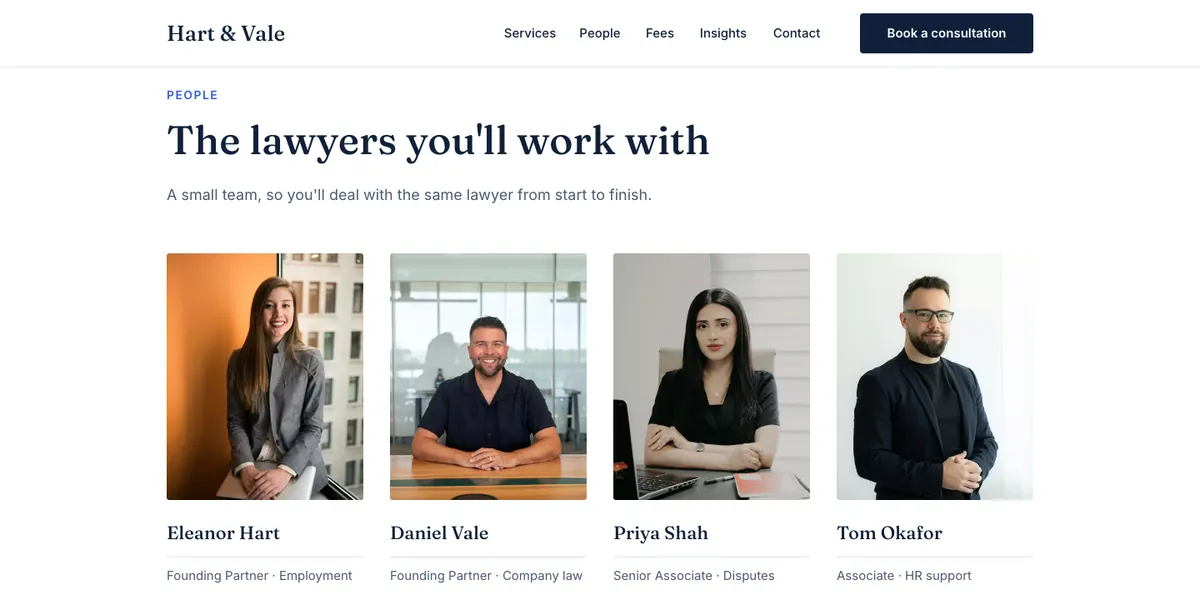
For a service where trust is the product, the people are the About page. This law firm’s heading says exactly why the faces are there: these are the lawyers you will work with, and the line under it promises you will deal with the same one from start to finish. Each card adds a role and the area of law, so a visitor can find the right person before they call.
Take from it: write the heading from the customer’s side. “The lawyers you’ll work with” beats “Our team”.
4 Show part of a bigger team: Kilo Forty
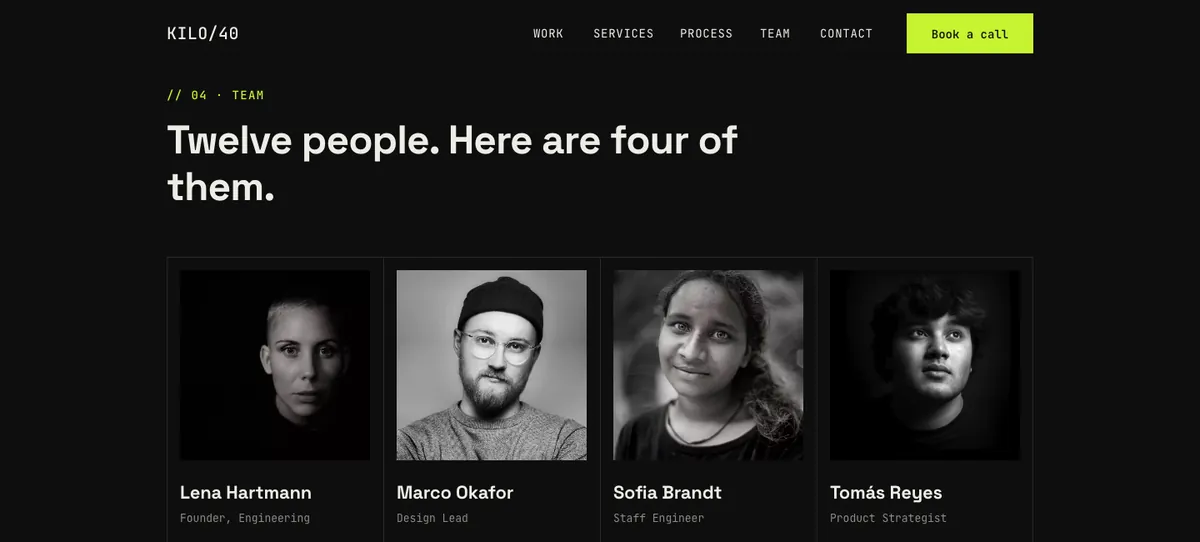
You do not need everyone on the page. This studio says how big it is, twelve people, and shows four, with the same photo treatment for each so the section looks deliberate rather than gathered from a group chat. The heading does the counting, so the grid can stay small.
Take from it: consistent photos matter more than many photos. Same crop, same background, same color or the same black and white.
5 Lead with what you believe: Halden & Vos
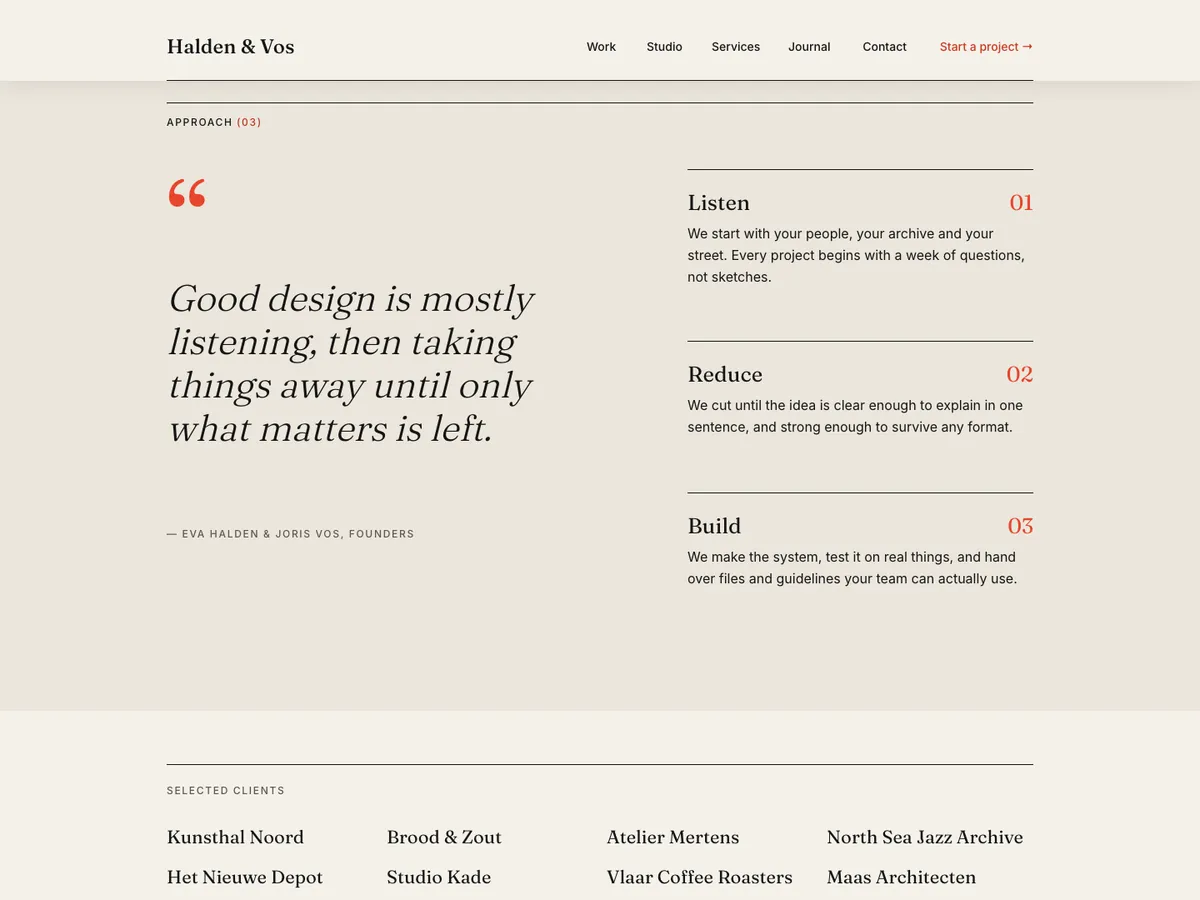
Values pages often fail because they list words every company claims: quality, integrity, passion. This studio writes one sentence that a competitor could disagree with, signs it with the founders’ names, and then shows what it means in practice in three steps. Below it, a short list of clients is the evidence that the approach works.
Take from it: a value is only useful if it changes how you work. Show the step it changes.
6 Say who you are in a few lines: Red Room
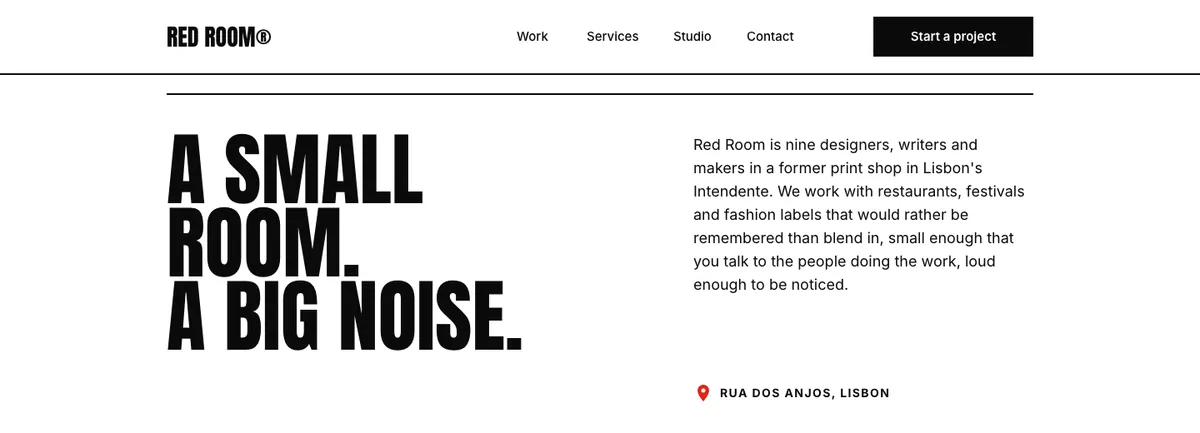
An About section can be short and still say everything. This agency fits it into one paragraph: how many people, what they do, where they work, which kinds of clients they serve and what those clients want. The big headline gives it a voice; the paragraph gives it facts.
Take from it: if you can only write four sentences, make them who, where, for whom and why.
7 Show the impact, not just the mission: Riverkeep
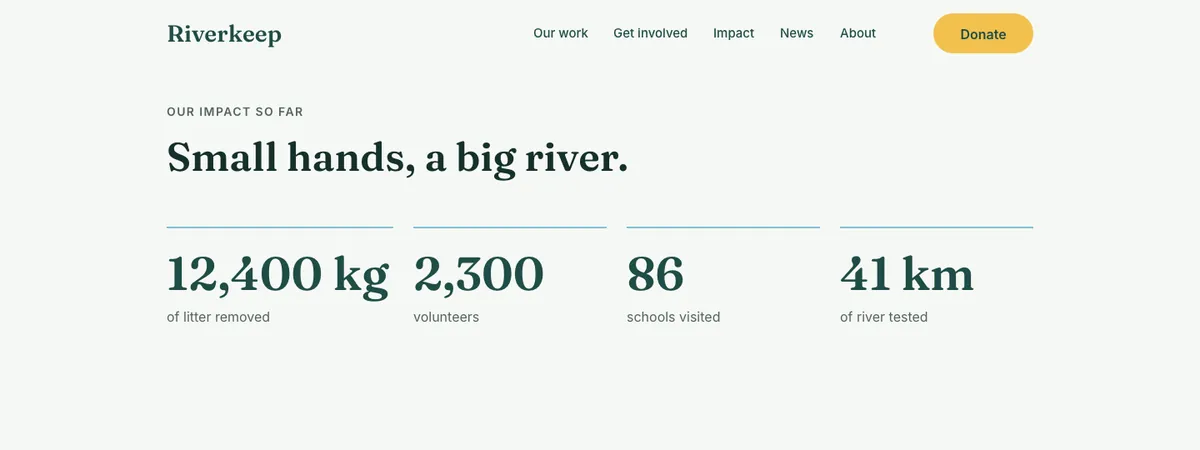
A charity or a cause-led business has a mission, but visitors believe results. This river charity puts its mission in a short headline and then proves it with four numbers, each with a unit that makes it concrete: kilograms of litter, volunteers, schools, kilometers of river.
Take from it: measure what you do in units people can picture, and keep the numbers current.
8 Answer the worry before it is asked: Flowright
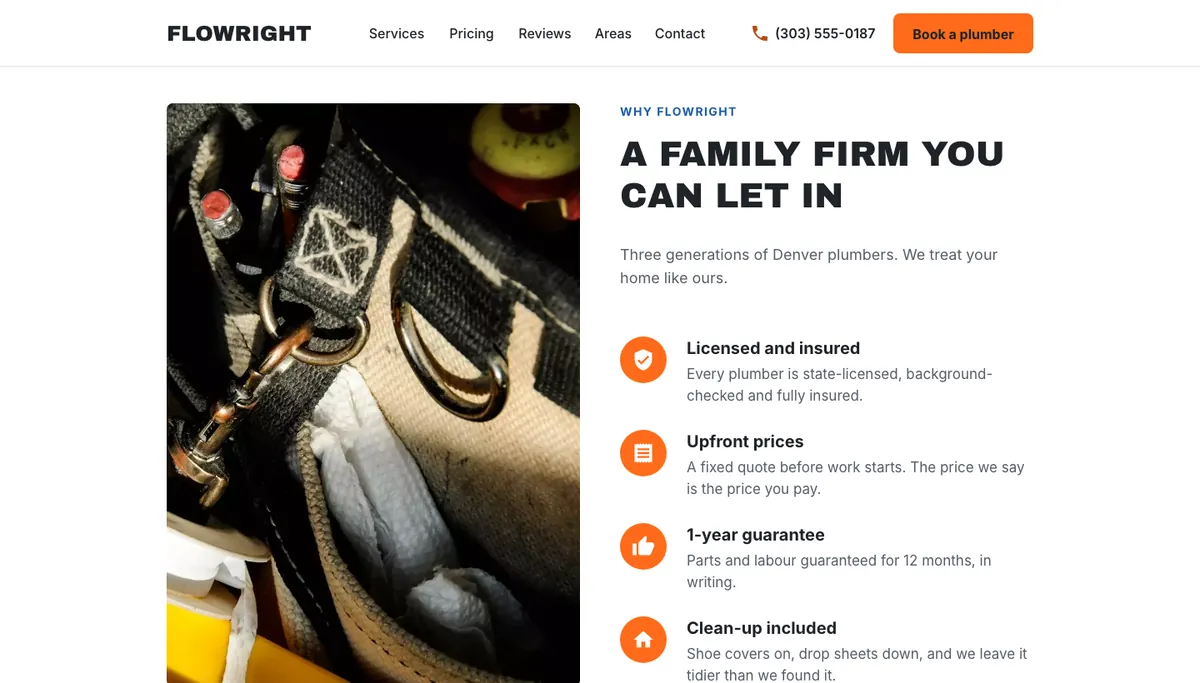
For a local trade, the question behind the About page is often “can I let this person into my home?”. This plumber answers it in the heading, then backs it up with the four things a homeowner worries about: licensing and insurance, the price, what happens if the repair fails and the mess. “Three generations of Denver plumbers” does the storytelling in one line.
Take from it: list your customers’ worries, then write one line answering each.
9 Make the people approachable: Brightside Dental
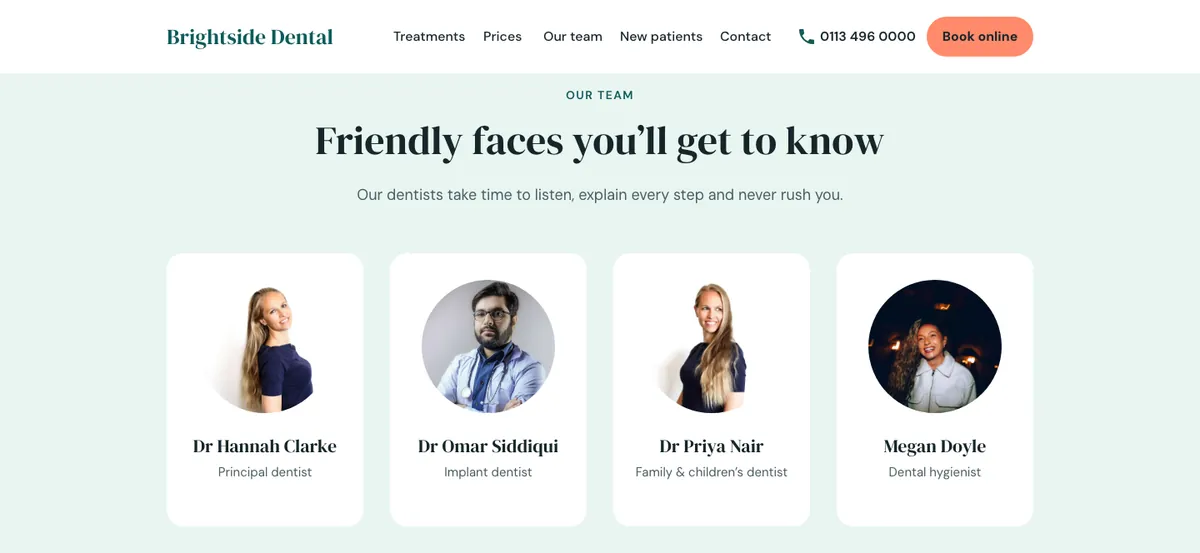
Some visitors arrive nervous. This practice uses its team section to calm them: a warm heading, a subtitle that promises they will not be rushed, and roles in plain English such as “Family & children’s dentist” rather than a list of qualifications.
Take from it: write the roles the way a customer would describe them.
10 Show how the work is made: Ondine
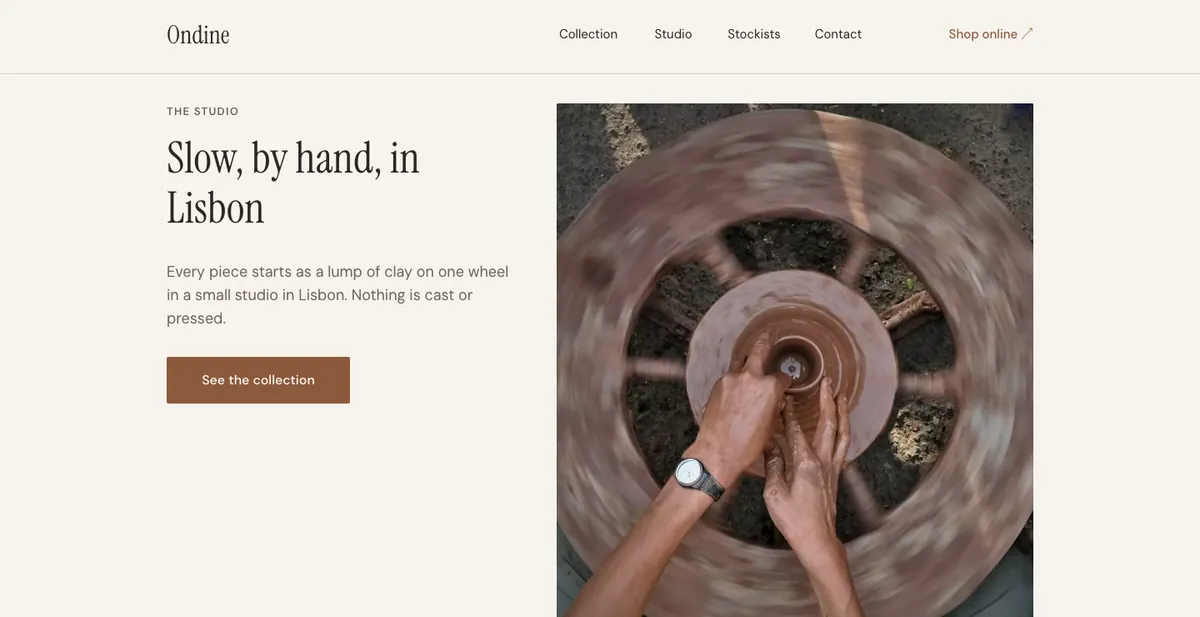
For makers, the process is the About page. This ceramics studio says where the work is made and how, in two sentences, next to a photo of hands at the wheel. Then it links straight to the collection, because a visitor who has just learned how the cups are made is ready to see them.
Take from it: end your About page with a link to what you sell. Interest is highest there.
What to put on an About us page
Every example above picks one thing to lead with. Whatever you choose, most good About pages answer the same six questions:
- Who you are. A name, a face, and in a team, the people a customer will meet.
- What you do and for whom. One plain sentence, in case the visitor skipped the homepage.
- Why you do it. The reason the business started or what you believe, in a sentence someone could disagree with.
- Where you are. A town or a neighborhood matters to local customers, and it makes you real.
- Why they can trust you. Years in business, clients, credentials, guarantees, numbers.
- What to do next. Book a call, see the work, visit the shop, get in touch.
What to leave out: a timeline of every office move, a list of values nobody could disagree with, stock photos of people who do not work there, and a mission statement longer than three lines.
How to write an About us page
- Write down the questions customers ask before they buy from you, on the phone, in emails, in reviews. Your About page should answer the ones about you.
- Pick one thing to lead with: your history, your people, your belief, your results or your process. The examples above show each.
- Write the first draft as if you were telling a customer in person. Then cut it by a third.
- Use “we” and “you”, or “I” if you work alone. Writing about yourself as “the company” makes a small business sound like a bank.
- Replace every adjective with a fact. “Experienced” becomes “nine years coaching 240 leaders”.
- Add real photos. Of you, your team, your place or your work, in the same light and style.
- End with one next step. A single button works better than a list of links.
- Read it on a phone. If a paragraph runs past one screen, split it or cut it.
Building it in Siter.io
If you want to build your About page without code, Siter.io is a website builder where you design each section on a free canvas, and every example in this post is a website template you can start from and change. For the people part, a meet the team page is built on Siter.io’s CMS: add each person once, with a photo, a role, a short bio and a longer About, import a staff list from a CSV file, and show the team on any page. Design the profile page once and everyone gets one of their own.